

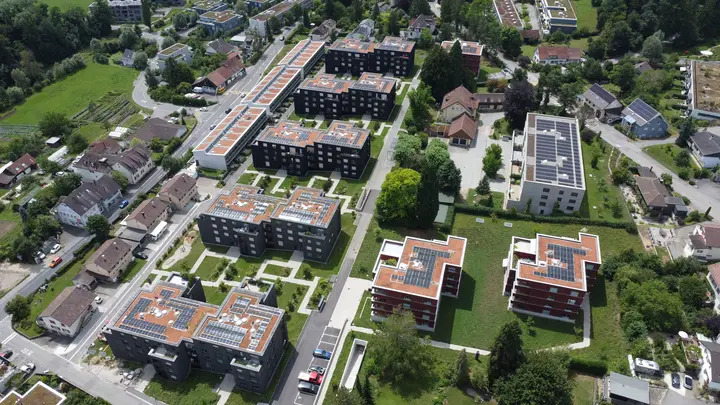
Pooling for personal consumption [ZEV], virtual pooling for personal consumption [vZEV] and local electricity co-operative [LEG]
We make personal consumption models manageable for property owners, property management companies and site operators, both technically and administratively. We combine photovoltaics, consumption data and billing to create a solution that works in practice.
Personal consumption is only worthwhile if it does not become an administrative problem. Anyone sharing solar power needs clear data, straightforward rules and a billing system that works reliably. This applies to traditional pooling for personal consumption [ZEV] solutions as well as to virtual pooling for personal consumption [vZEV], a local electricity co-operative [LEG] and billing for energy and water costs based on consumption [VEWA] models.
We support our clients every step of the way, from the initial concept right through to ongoing operations. We clarify the requirements, develop a reliable billing system, establish the data foundation and ensure that personal consumption remains economically viable and transparent.
This turns a technical possibility into a solution that can be managed within the company. Property owners and management companies can use solar power without having to set up additional in-house resources for administration, data processing and billing.
Benefits at a glance
- Making personal consumption economically and administratively manageable
- A clear data foundation for electricity, heating, water and service charges
- Relieving the burden on property owners and management companies during ongoing operations
- Linking PV and site models, consumption data and billing
- A scalable solution for newly constructed buildings, existing properties and sites
Downloads
What is meant by a "private consumption community" (ZEV)?
A private consumption community (ZEV) is a regulated model in which multiple parties jointly consume locally generated electricity. These could be the residents of an apartment block who share a solar power system. As a ZEV, they constitute a collective end consumer that has a single grid connection point. This means that the electricity is not drawn individually from the public grid.
Rapp offers comprehensive services to operators of ZEV private consumption communities. Among other things, we provide advice on this topic. We also offer a simple and clear portal through which the electricity produced by the photovoltaic system is billed.
A ZEV private consumption community reduces the costs for owners and/or tenants. This is because they do not have to pay any grid utilisation fees or other charges for the electricity they produce locally. How the electricity volumes are distributed and accounted for within a ZEV is regulated internally.
As of 2025 it is possible to form virtual private consumption communities (vZEVs), in which electricity does not necessarily have to be consumed at the same location. Each participant retains their own grid connection, which means that there are several totalisers at the grid operator. The grid operator calculates the current flow as if the participants were connected together.
What is the legal framework for ZEVs in Switzerland?
Rapp supports the formation of ZEV private consumption communities in a number of ways. It goes without saying that our experts are familiar with the applicable legal requirements. These framework conditions are particularly relevant:
- In accordance with Article 16 of the Energy Act (EnG), operators of photovoltaic systems may consume the electricity they generate themselves. However, it can also be sold in whole or in part, which is also regarded as own use. This is the legal basis for a ZEV.
- Article 17 of the Energy Act grants the option of establishing a ZEV.
- The Energy Ordinance (EnV) sets out the conditions that apply to a ZEV. Among other things, it stipulates the requirements for communities and defines how billing is to be handled.
- The Electricity Supply Act is also relevant because it stipulates that a ZEV is treated as an end consumer rather than an energy supplier.
In accordance with the legal requirements, a ZEV must act as a single entity vis-à-vis the grid operator. This means that there can only be one totaliser – unless it is a vZEV.
The totalising meter records how much electricity is drawn from the grid. The meter also records how much electricity is fed into the public grid. It is up to the ZEV participants to decide how they organise their own consumption.
The accounting within a ZEV must be clear and comprehensible. It must show how much electricity participants have used and how much it has cost. Rapp supports the customised accounting of ZEVs with innovative solutions.
Every participant in a ZEV may leave it and then has the right to obtain an individual connection from the network operator again. All participants must be informed transparently about the conditions for this kind of exit, such as the time frame.
How does Rapp help operators with the implementation of a ZEV?
Rapp offers various services that support ZEV private consumption communities. These mainly comprise the following:
- Advice: We provide support with the planning and pricing of a ZEV. We also carry out feasibility studies and profitability analyses, and compare the possible variants with each other.
- Accounting and administration: We have developed an online platform that ZEV operators can use to manage their accounting, eliminating the workload that this would entail. The data is stored in the cloud, which means that it can be viewed by tenants and administrators at any time. At the same time, the data in the portal is protected against unauthorised access.
- Energy management and monitoring: We install precise, intelligent measuring devices such as smart meters that record electricity consumption. We analyse the recorded values, which ensures transparent accounting for ZEVs. We also identify whether there is potential for optimising electricity consumption.
With our services, we help building owners and operators with the implementation of ZEVs.
It is possible to feed unused electricity into the public grid, and thus benefit financially from the feed-in tariff. Rapp takes care of the entire administrative processing of feeding electricity into the grid.
Who can benefit from a ZEV?
The following groups of people in particular stand to benefit from Rapp's services for ZEV private consumption communities:
- Owners of detached houses with their own photovoltaic systems can form a ZEV private consumption community with their neighbours. This allows them to get the best possible use out of their system, for the benefit of several households. However, all participants must be connected to the same neighbourhood distribution box (except for vZEVs). Rapp handles the planning and launch of the ZEV.
- Thanks to Rapp, property management companies have a centralised solution for ZEV accounting. Above all, they appreciate the high quality of our data.
- Electrical installers use Rapp's expertise when it comes to selecting the right products for their customers. We are manufacturer-independent, and therefore only propose solutions that we firmly believe in.
Related area of activity
Consumption data management
We make energy consumption visible. We collect, verify and organise consumption data to enable owners, property managers and operators to explain costs in a transparent manner, prepare accurate bills and make well-informed financial decisions.
Energy and water measuring systems
Reliable billing starts with reliable measurement data. We design, install and operate energy- and water-measuring systems that accurately record consumption data and make it available for billing, monitoring and optimisation.
Energy concepts for local authorities and sites
We show local authorities, property owners and site operators the economically viable path to a sustainable energy supply. We examine options, assess costs and benefits, and provide the basis for decisions to ensure realistic implementation.
Photovoltaics and eMobility
We support local authorities, businesses and property owners in making cost-effective use of solar power and integrating e-mobility in a practical way. We identify opportunities, develop robust concepts and support their implementation right through to the operational phase.