

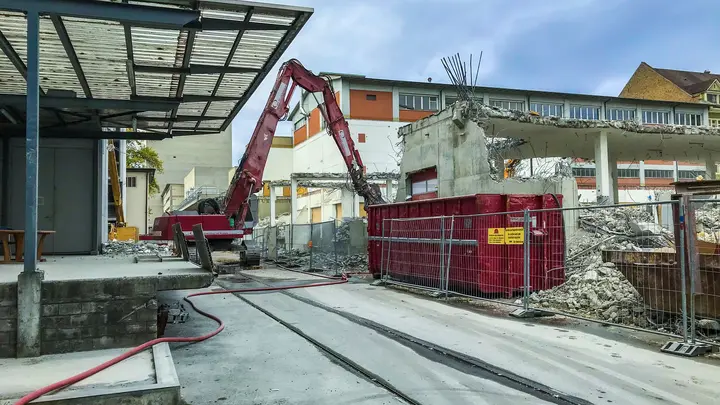
Deconstructions are usually carried out in direct connection with new use requirements. The professional removal of contaminants from buildings and the disposal of harmful materials in the soil must be defined as early as the planning phase. Efficient coordination of intersection points with the construction of the new building can optimise construction costs.
We possess the competence required to carry out the timely and economical planning and execution of your project.
What asbestos removal services does Rapp offer?
Asbestos was once regarded as an ideal material for use in construction. But then it was discovered that asbestos dust poses a health hazard, which is why asbestos was banned in Switzerland in 1990. Nevertheless, asbestos can still be found in many buildings today. Asbestos removal is necessary to replace it with materials that are not harmful.
Although Rapp does not carry out asbestos removal work itself, it does offer various services in this area. This includes, for example, analysing buildings for asbestos and other harmful substances such as
- Polychlorinated biphenyls (PCBs)
- Chlorinated paraffins (CPs)
- Polycyclic aromatic hydrocarbons (PAHs)
Our experts use various methods to determine whether a building contains asbestos. This includes visual inspection for typical asbestos-containing building materials. Samples are also taken and analysed in the laboratory. If asbestos is detected, a risk assessment is carried out.
Under certain conditions, the asbestos can remain in the building. However, if there is a risk to residents or users of the building, asbestos removal must be carried out. An asbestos test is particularly useful for buildings constructed in the 1950s, 1960s and 1970s.
We also collect non-hazardous materials as part of asbestos removal projects. This means they can be reused in other construction projects. This kind of reuse makes sense, especially for reasons of sustainability.
What technology solutions does Rapp use for efficient, safe asbestos removal?
Rapp has many years of experience and expertise in the planning and monitoring of asbestos removal. One of the solutions we use involves taking samples. Depending on the homogeneity of the material, these are individual or mixed samples. These are analysed for asbestos in the laboratory.
We also use measuring devices that determine the concentration of asbestos fibres. This allows us to determine whether contamination is present during approval measurements.
We use the GIS-based software PlanRadar for our work. It can be provided with detailed building plans and other documents. An application from the software provider can be used to create markings on the plan during the examination. This makes it clear to everyone involved in the project where asbestos and other pollutants are located.
The documentation can consist of notes, photos and videos. These can be uploaded via the app and are therefore also available to the team. The plan can also include notes on where samples were taken. Following the inspection, the software creates an asbestos report that summarises all the information collected.
What expertise does Rapp have with regard to analysing pollutants?
Rapp employs a team with members who have undergone training and passed a federal examination in asbestos and pollutant diagnostics. In addition, they have completed training to become specialised construction supervisors. Our experts have many years of experience in analysing pollutants. Rapp is a member of various trade associations that are committed to the clean-up of harmful substances.
Our team is at your disposal for projects of all sizes. It carries out rough screenings as well as detailed pollutant analyses. We are also extremely flexible when it comes to the scope of planned pollutant and asbestos removal. We are happy to accompany smaller refurbishments of individual flats and detached houses.
We are also available for extensive projects. In the past, for example, we have completed the demolition of the Isemeyer site in Rheinfelden. During the planning phase, our team was responsible for analysing pollutants in the buildings to be demolished. We summarised the results in a pollutant report. One of the aims of the analyses was to identify pollutant-free materials for reuse. Thanks to our work, it was also possible to dispose of the pollutants properly.
How does Rapp ensure compliance with legal regulations when analysing pollutants?
Persons entrusted with analysing pollutants must be specially protected in their work. This is to prevent them from suffering damage to their health. This is stipulated by law in various places – including the Swiss Federal Act on Environmental Protection.
Our team of experts who carry out the pollutant analyses wear protective clothing without exception. FFP3 masks in particular are indispensable at work, as inhaling asbestos dust can cause considerable damage to health. The samplers' equipment also includes airtight suits.
Our team of experts always works in pairs when analysing pollutants. The reasons for this are as follows:
Despite all precautionary measures, emergencies can occur when working with hazardous substances. If someone is injured or faints, the other person can provide first aid or help in another way.
- If two people are involved in taking the sample, there is less risk of errors. No materials or areas are overlooked, which improves the quality of work.
- A witness is always present when samples are taken. This ensures complete documentation and helps with any legal consequences.
All samples taken are analysed exclusively by certified laboratories. We also instruct the employees of companies involved in asbestos removal and dismantling in the correct procedure.
Related area of activity
Environment
Our experience ensures that environmental concerns are always taken into account in accordance with statutory regulations and ecological requirements.
General Planning
We plan and coordinate every aspect of your construction project.
Safety and Security
Optimum protection – we ensure that the safety of people and the environment is guaranteed even in the event of an incident.
Site traffic and parking
Changing requirements and unutilised commercial potential motivate owners to convert and develop plots. Data that is up to date and free of redundancies is essential both in this regard and for planning purposes – you can count on us as experienced consulting and planning partners.