

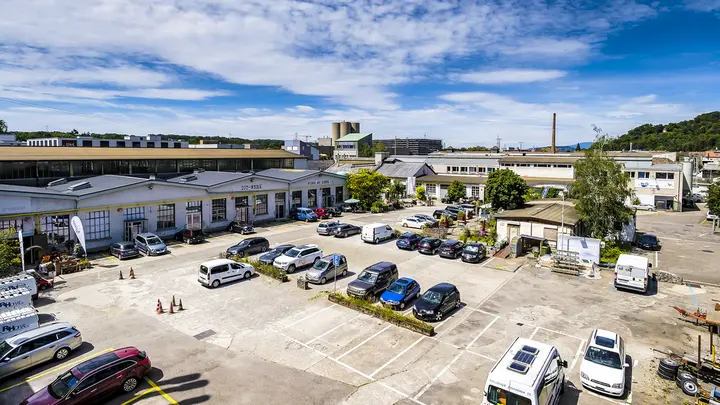
Site traffic and parking
Changing requirements and unutilised commercial potential motivate owners to convert and develop plots. Data that is up to date and free of redundancies is essential both in this regard and for planning purposes – you can count on us as experienced consulting and planning partners.
The development and utilisation of numerous plots no longer coincides with effective requirements in terms of logistical, technical and traffic-related processes. Economic potential is going to waste. Our all-rounders and specialists analyse the options open to these sites alongside the requirements of the owners or potential users and develop new usage concepts.
Having fast access to the latest data is essential with regard to decision making and managing company plots and leads to savings in terms of time and money. Our information system guarantees a clearly structured and logical display that satisfies numerous planning, safety and intervention requirements.
What steps does the site development process involve at Rapp?
Site development revolves around the creation of utilisation concepts for sites. In particular, the structural, social and economic benefits of the planned project are considered.
A site is developed in several stages, beginning with an analysis of the location. A feasibility assessment is also carried out in an early phase of site development. We then derive appropriate utilisation or development concepts from the findings. On request, we can also support the implementation of the developed concept.
You benefit from our team's multidisciplinary composition, which enables us to cover a very broad range of services. In addition, all our employees have a great deal of expertise and experience in their respective fields.
We will be happy to provide detailed information about the measures we can take in site development. Do not hesitate to contact us.
What role do urban planning and architectural aspects play in site development?
Site development usually involves the preparation of a construction project. Urban planning and architectural aspects therefore play an important role. Ultimately, the planned project should blend in with its surroundings as effectively as possible. This applies in particular to the architectural design.
One of the most important tasks of site development is therefore to harmonise the planned projects with the existing structures, in the case of both new buildings and extensions and existing structures.
In addition, the site needs to be developed with a number of aspects in mind. For example, transport links and the need for parking spaces are often a decisive factor. Coordination with the existing structures is essential.
If necessary, a review should be carried out of whether existing bus and tram lines need to be extended or their routes changed. New stops or track systems will then have to be planned. The road network will also be affected by the site development. To name just two aspects, roads will need to be extended and traffic lights planned.
The Rapp team will be at your side for all these tasks. Our employees have the required expertise in all areas relevant to site development.
How is coordination with the relevant authorities and compliance with legal requirements ensured during site development?
Site development is not just about designing a project on site. The extent to which the project is feasible in practice also has to be examined. Legislation plays a decisive role here. The compatibility of the project with the prevailing laws has to be clarified. This requires close coordination with the responsible authorities.
At Rapp, we are happy to take care of communication with the authorities. This saves our customers a lot of time and energy. You can concentrate on other project-related activities.
The legal requirements relate to compatibility with the applicable environmental legislation, for example. Relevant aspects include:
- Air pollution control
- Soil contamination
- Chemical risk reduction
- Deforestation
The authorities are responsible for compliance with the law, but they will often help to find alternative solutions. With us, you will have a partner at your side who has a great deal of experience in dealing with the authorities.
What methods and tools does Rapp use to visualise and present site development concepts?
We use various methods to visualise site development concepts. These include the use of drones, with which we take photos and videos from the air in order to give those involved an optimal overview of the site. The drone images can also be used for precise surveying.
Another option for visualisation is to create 3D models. These can be either physical or computer models, and are based on drone images or other surveying methods such as laser scanning.
With the help of a model, the site can be visualised before planning begins. For example, you can see how the planned development of the new site fits into the surroundings.
How are ecological and sustainable aspects integrated into site development?
Sustainability is a top priority for Rapp in every project. It is important to us for new buildings, conversions and extensions to be realised in harmony with the environment. Energy management is of particular importance here.
For example, photovoltaics and e-mobility play an important role for us. Generating energy from solar power is environmentally friendly, reliable and also cost-effective. It serves to protect and preserve the environment when integrated into newly developed sites.
In the field of e-mobility, we are happy to develop concepts for public and private transport. This involves, for example, the provision of charging stations for e-cars or the infrastructure for e-bike sharing.
Please feel free to contact us if you would like to find out more about sustainability in site development.
Related area of activity
Construction Logistics
To build where buildings already exist. Constructing a new building or a conversion in the heart of the city or on an existing company plot is a challenging undertaking. Making these construction sites accessible sometimes calls for extraordinary feats. We have the long-standing experience to help you coordinate your construction logistics.
Deconstruction and remediation
We carry out economical and ecological conversions of industrial buildings and urban consolidations.
Environment
Our experience ensures that environmental concerns are always taken into account in accordance with statutory regulations and ecological requirements.
General Planning
We plan and coordinate every aspect of your construction project.
Plant Pipelines, Pipeline Construction
We develop innovative ideas for the design and installation of utility lines and pipelines. The same approach also applies to industrial plants.
Safety and Security
Optimum protection – we ensure that the safety of people and the environment is guaranteed even in the event of an incident.
Traffic Planning
Designing sustainable, economic, efficient and safe traffic systems for the future is a comprehensive responsibility for traffic planning that we are happy to take on.
Water & Wastewater
Water is an essential resource. It is one we protect with foresight, both with regard to the supply of fresh water and the disposal of wastewater.