

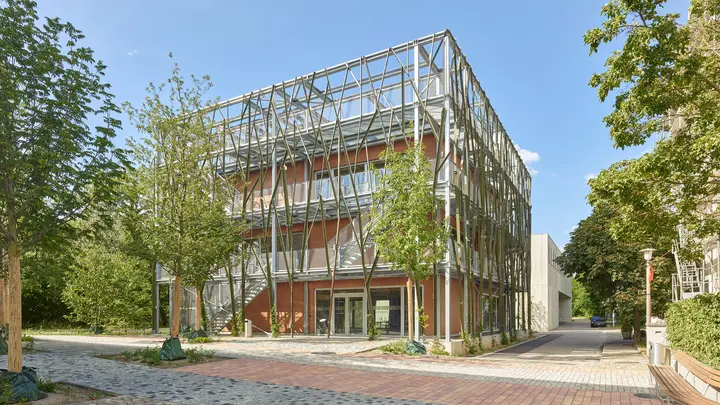
Sustainable Planning and Construction
From the initial vision to successful realisation. As an interdisciplinary partner, we combine the expertise of our specialists derived from sustainability, architecture, infrastructure, energy, mobility and logistics to form an intelligent whole. This close cooperation creates efficiency and space for innovation, achieving an impact with a sense of foresight.
Rapp AG supports its clients through sound advice and innovative solutions for sustainable development of the built environment, mobility, energy systems and logistics. Our goal is to work together to realise projects that harmonise ecological, economic and social aspects.
When it comes to sites, buildings and infrastructure, we endeavour to preserve existing structures and, in the interest of circular construction, employ construction methods that conserve resources and focus on the reusability of structural components and materials – an approach that is adopted over the entire lifecycle.
We support you during the development and implementation of sustainability strategies and measures, both with or without label certification. We provide support where construction methods which are ecological and free of toxins are employed, ensuring that environmental issues are taken into consideration in terms of compliance with the law. Moreover, we develop targeted measures to protect and promote the biodiversity of habitats.
We support you in designing habitats for the future.
Thanks to our expertise in climate-compatible urban development and sponge city principles, we can provide advice on rain water management and the design of resilient urban spaces that promote natural water cycles, enhance the quality of life and are more capable of withstanding extreme weather events.
Through our services in the areas of mobility and logistics, we support you during the development of sustainable concepts and illustrate methods for decarbonisation, including through the use of zero-emission drives or integration of multimodal mobility solutions.
In the energy sector, we provide support for you through holistic concepts on the road to net zero. We achieve this through the use of renewable energies and integrated solutions for greater energy efficiency. Our consulting is tailored to individual needs, implementation-oriented and practical – for projects with long-term added value.
Our servicesStrategies and concepts
Certifications and labels
Energy, climate and the environment
Circularity and construction work on existing buildings
Project support and digitisation
|
Introductory talk on sustainability
Are you interested in a free, no-obligation introductory talk?
What is sustainable construction?
Sustainable construction aims to protect the environment to the greatest possible extent. It includes the following aspects:
- Sustainable materials
- Short transport and access routes
- Conserving resources
- Low energy consumption
- Minimal land use
In sustainable construction, everything is geared towards protecting nature and the environment. This is primarily to minimise greenhouse gas emissions. It may involve the use of recycled materials from previous construction projects, so that no new building materials have to be produced.
In all its construction projects, Rapp is committed to a climate-neutral approach. We keep emissions and waste to a minimum. And sustainability strategy is not just something that we do ourselves. We also advise other companies, for example on the use of sustainable energy sources.
Sustainable construction also involves dealing fairly with everyone involved. A positive working environment brings benefits, and this includes productivity. Rapp has created a working environment that is satisfactory for the overwhelming majority of its employees. We promote gender equality and welcome people with disabilities. We have thereby positioned ourselves for the future.
What are the ecological aspects of sustainable construction?
The first priority in sustainable construction is to reduce emissions to a minimum. Climate change will drastically alter life on earth in the coming years. Stopping its advance is therefore a matter of urgency.
The construction industry produces a very large amount of greenhouse gases. Rapp strives to keep emissions as low as possible during the implementation of its construction projects.
One way we achieve this is by using renewable or recycled construction materials. We also aim for short distances when transporting materials to construction sites. The people working on those sites should also have as short a journey there as possible. Ideally by making use of eMobility.
Rapp gives high priority to sustainability in every project it takes on. And it does so consistently, starting from the outset and continuing until successful conclusion. We also encourage our employees and partners to learn more about sustainable construction. This makes us a pioneer in this field in Switzerland.
What materials are used in sustainable construction?
One of the principles of sustainable construction is the use of materials that do not harm the environment. These include renewable raw materials, primarily wood. In Switzerland, about five million cubic metres of wood are harvested annually. It is increasingly being used for building construction.
At Rapp, we also regularly rely on the positive properties of wood as a building material. For example, from 2019 to 2022 at the headquarters of Primo Energie in Münchenstein, we erected a three-storey building with a timber frame construction. The construction interior is left unclad, revealing an unusual view of the massive wooden beams.
Sustainable construction also involves recycled materials that were previously part of other construction projects. This may be wood or another material. The term for this method is circular construction.
When a building is to be dismantled, its materials are examined for possible reuse. If they are in good condition, they are saved for use in a new construction project. This is also how the new Primo Energie building in Münchenstein was built. For example, half of the wooden floorboards used on the upper floors came from a boathouse that was more than 100 years old.
How can existing buildings be renovated sustainably?
Working with a sustainability strategy is not just for new construction projects. These principles should also apply to the renovation of existing structures.
Renovation involves restoring an ageing building to as new a condition as possible. Sustainable or recycled materials should be used. It may be possible to reuse the building’s original materials. If they have to be replaced, this should be done through circular construction.
Renovation usually also aims to reduce a building’s energy consumption. This may involve improved insulation, for example, thereby reducing the requirement for heating in winter and air conditioning in summer. Sustainable insulation can be achieved through the use of cellulose, for instance. This material is obtained from trees and other plants and is therefore renewable.
The installation of modern windows and doors is also a proven measure in renovation. However, you should first ascertain whether new windows and doors are actually required. This is because replacing the seals is usually sufficient for energy-saving insulation.
Wooden floors are also a sustainable measure. They provide insulation too, both in terms of temperature and noise. In addition, wood enhances the interior ambience and is welcomed by those who suffer from allergies.
What are building certifications and how does Rapp support you?
Building certifications are carried out by independent organisations. Among other things, they provide investors with important information on the current value and value stability of the building. The most important building certifications are
- Minergie (organised by regional Minergie agencies)
- SNBS (Swiss Sustainable Building Standard; carried out by the Swiss Sustainable Building Council (SGNI)
- DGNB certification (also carried out by the SGNI, based on criteria of the German Sustainable Building Council)
Rapp supports certification by these organisations as part of a planning mandate. This certifies that the overall energy balance of the building has been optimised. This is achieved by maximising energy savings and reducing CO2 emissions.
Why are building certifications important and what added value do they offer, according to Rapp?
Building certifications serve to strengthen the trust of various groups of people and institutions – especially of
- consumers
- customers
- companies
The certification proves that the building fulfils certain standards and quality features. The criteria that must be met for certification are based on the requirements of sustainable building. Rapp actively supports building owners in obtaining the certifications.
What are the advantages of working with Rapp to obtain building certification?
Building certification increases the chances of selling or letting the building. This is because certification makes the high quality of the property visible and therefore convinces potential owners or users.
If the integral planning of the construction project is already carried out with a view to building certification, there are further advantages. This allows optimisation potential to be identified at an early stage during construction and subsequent operation. Any conversion or demolition work can also be taken into account from the outset.
In addition to providing support with building certification, Rapp also carries out a life cycle analysis in which our experts analyse the effects of the property on various aspects. These include economic and social aspects as well as biodiversity. Thanks to the multidisciplinary composition of our team, you receive all relevant services from a single source.
What are sustainability labels and how does Rapp provide support in obtaining them?
Sustainability labels show that the construction of an object or the provision of a service is carried out in an environmentally friendly way. There are sustainability labels for various sectors, including the construction industry. The best-known sustainability labels in Switzerland are Minergie-P, Minergie-A and Minergie-ECO as well as SNBS and DGNB.
Rapp provides support in obtaining such a label. We support construction projects right from the planning phase, laying the foundations for achieving the defined criteria. The result is a building that is built and operated sustainably.
What sustainability labelling trends is Rapp following?
Rapp's services are primarily geared towards the needs of the Swiss market. Thanks to our activities on the German market, we are also familiar with DGNB certification. In addition, many European standards also apply to Switzerland.
We are always up to date with the latest amendments to environmental legislation. When we work with a customer, we draw up an individual catalogue of criteria. On the basis of the customer's needs, we then summarise which aspects of the various sustainability labels are important to them.
What services does Rapp offer in connection with the GEAK?
The cantonal building energy certificate (GEAK) provides information on the energy status of a property. The certificate is issued in seven classes, with A standing for "very energy efficient" and G for "less energy efficient". A building is judged in the following categories:
- efficiency of the building envelope
- overall energy efficiency
- local CO₂ emissions
It is also possible to apply for the GEAK Plus. In addition to the GEAK analysis, the applicant then receives suggestions on how best to carry out the energy-efficient refurbishment.
At Rapp, we are experts in the GEAK criteria. Our team helps to fulfil the requirements for the best possible classification. This increases the value of the property and convinces potential owners and users. It is also in an environmentally friendly and sustainable condition.
How does Rapp help to carry out a GEAK analysis?
Rapp supports you in several steps on the way to the GEAK. First of all, the need for action must be recognised. There must therefore be an interest in significantly reducing the property's energy requirements and CO₂ emissions. This can be achieved by refurbishing the thermal building shell and the building technology.
To obtain the GEAK, first obtain quotes from GEAK experts. We at Rapp are one of them. Most cantons and municipalities subsidise the preparation of GEAK and GEAK Plus. This saves you money when creating them. The subsidy must be applied for before the start of construction.
The actual condition of the building is recorded for the preparation of the GEAK. On this basis, advice is given on how to proceed and how the building can achieve a better categorisation.
At Rapp, we support you in this phase with our expertise and experience. We will make suggestions as to what measures are sensible for refurbishment. You decide which measures are ultimately taken.
We are happy to take over the planning of the refurbishment measures. This includes selecting the companies involved and applying for funding. On request, we can also participate in the realisation of the renovation. We take over the general planning and are therefore responsible for the quality and schedule. And we keep the costs under control.
With construction management from Rapp, you have just one point of contact who will keep you informed about the status of the renovation work.
Related area of activity
Architecture
We relish being presented with demanding architectural challenges.
Consultancy on public transport
Setting the right course.
Coordination and planning for project developments
Do you have a location, an idea or capital and want to create sustainable value through structural development? We'll assist and support you from the beginning of your project with professional and interdisciplinary skill.
Deconstruction and remediation
We carry out economical and ecological conversions of industrial buildings and urban consolidations.
Energy and resource efficiency
We support our clients in the analysis of processes, efficiency improvement measures and decarbonisation strategies for production facilities and buildings.
Energy concepts
We develop intelligent energy concepts for innovative building and site solutions, thus contributing towards an economic and sustainable energy supply.
Environment
Our experience ensures that environmental concerns are always taken into account in accordance with statutory regulations and ecological requirements.
Mobility Services and New Mobility
We lend a hand in the development, implementation and support of new mobility forms and alternatives.
Photovoltaics and eMobility
We support our clients with preliminary clarifications, feasibility studies and conceptual design, and we accompany them from the tendering process to quality control and in the operation of renewable energy systems.
Private consumption community (ZEV)
We offer operators of private consumption communities (ZEV) a comprehensive service and a simple and clear portal for the billing for self-produced electricity from photovoltaic (PV) systems.
Site traffic and parking
Changing requirements and unutilised commercial potential motivate owners to convert and develop plots. Data that is up to date and free of redundancies is essential both in this regard and for planning purposes – you can count on us as experienced consulting and planning partners.
Support Structures
We design supporting structures made of concrete, steel, wood and masonry for almost all types of buildings and carry out structural verifications, expert reports and structural repairs for you.
Water & Wastewater
Water is an essential resource. It is one we protect with foresight, both with regard to the supply of fresh water and the disposal of wastewater.