What is plant and logistics planning?
Plant and logistics planning refers to the structured, systematic planning of production facilities and logistical processes within a company. The goal is to increase the efficiency of core business processes through the optimum interaction between procedures and structures. Here are some important aspects of plant and logistics planning:
Plant and logistics planning usually involves analysing the value-added process. Within this framework, Rapp's experts analyse the various functions (main and secondary functions) within the company. The results of the analysis show the extent to which optimisation makes sense.
Especially for companies that are only just setting up their logistics, it is important to plan the relevant areas and buildings. This means that production facilities and warehouses can be designed to best meet the company's logistical requirements. The buildings can also be designed so that they can be easily expanded or used flexibly if required.
Existing or planned buildings can be the subject of a building simulation in which functionality and processes are scrutinised and checked/approved before realisation. Potential improvements or bottlenecks can be recognised at an early stage and addressed in good time during the planning phase.
Logistics system consulting can also include planning of logistics systems. Rapp advises on the selection and implementation of logistics systems that meet the company's specific requirements. Rapp also develops supply and disposal solutions, carries out workshop and operational planning and implements lean manufacturing methods.
Other aspects are analysed as part of plant and logistics planning, including material flow and layout planning. The goal is to optimise transport routes and internal processes. The efficiency and functionality of production planning and control systems are also tested. Another focus is on the ergonomic and productivity-enhancing design of workplaces. Consulting also includes the integration and optimisation of warehouse management, learning management and ERP systems. The range is supplemented by the concept of "Flexible Logistics Operations" (FLO), which analyses agile logistics solutions for adaptation to dynamic market requirements.
Why is professional logistics planning important for a plant?
Technically professional plant and logistics planning serves, among other things, to improve cost efficiency. Rapp advises companies on planning and managing their transport and warehousing processes, enabling them to reduce their costs significantly.
Measures implemented thanks to plant and logistics planning also ensure smooth, efficient processes along the entire value chain. They also help a company to remain competitive by making its production faster and more cost-effective.
Thanks to plant and logistics planning, the company can also react flexibly if market conditions or customer requirements change. It also utilises resources such as materials, personnel and time more efficiently. And last but not least, plant and logistics planning ensures quality assurance of both the materials used and the final products.
How does factory planning work at Rapp?
Rapp takes a very structured, systematic approach to factory planning. Firstly, the objectives and framework conditions of the planning are defined. They are based on the company's individual strategy.
Rapp's experts then record the current status of the company in order to obtain reliable planning data as part of the basic assessment.
A rough concept is then developed in which the main structures and processes are recorded. This is followed by the development of a rough concept that outlines the main structures and processes. The next step is to plan which implementation measures are to be taken. Commissioning of the new or optimised systems is also planned.
Once the concept has been implemented and the new structures and processes are up and running, continuous improvements will follow. Regular reviews are then carried out to determine the effectiveness of the measures. Changes in the market and in production are also taken into account. We respond flexibly to this by adapting the processes applied.
What aspects does comprehensive factory planning cover?
At Rapp, factory planning is also structured and systematic in order to maximise the efficiency of operating processes. Here are some of the key steps that Rapp carries out in factory planning:
- Analysing the value-added process: Analysing the main and secondary functions of the company to determine the best processes and systems.
- Planning of sites and buildings: Design of flexible and expandable production facilities and warehouses.
- Material flow and layout planning: Optimisation of routes and processes for material transport within the production facility.
- Production planning and control systems: Implementation of systems for efficient production planning and control.
- Logistics system consulting: Consulting on the selection and implementation of logistics systems that meet the specific requirements of the company.
- Workplace design: Ergonomic and efficient workplace design to increase productivity.
- Building simulations: Use of simulations to plan and optimise buildings and their processes.
- Supply and disposal solutions: Development of solutions for the efficient supply and disposal of materials.
- WMS / LMS / ERP interface consulting: Advice on the integration and optimisation of warehouse management, learning management and ERP systems.
- Workshop and operational planning: Planning and optimisation of workshops and operating facilities.
- Lean manufacturing: Implementation of lean methods to maximise efficiency and minimise waste.
- Flexible Logistics Operations (FLO): Agile logistics solutions to adapt to changing market conditions.
- Supply chain management: Holistic view and optimisation of the value chain.
- Relocation management: Efficient planning and realisation of company relocations.
This comprehensive approach ensures that all aspects of factory planning are taken into account to maximise efficiency and flexibility.
Why is professional warehouse planning important?
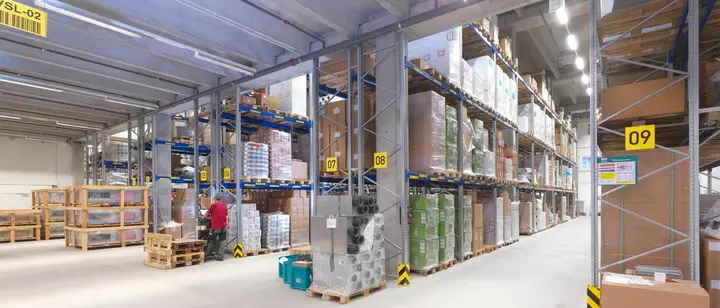
Professional warehouse planning is crucial to the success of a company that handles physical goods. Here are some of the most important reasons. Thanks to short distances and optimised processes, it saves time and minimises space requirements and operating costs. In addition, modern technologies and clear organisation reduce sources of error.
This is ensured not only by the well thought-out structure, but also by the flexibility created with the planning process. This enables those responsible to react quickly to changes in the market.
Compliant warehouse planning not only ensures the safety of employees and goods; it also forms the basis for the economic success of a company. Automated systems can significantly speed up processes, minimise error rates and reduce operating costs in the long term. In addition, AI-supported solutions enable precise control through intelligent predictions and real-time decisions – which significantly increases the efficiency and flexibility of warehouse processes. The targeted use of warehouse management systems (WMS) and other digital tools improves inventory management, ensures a high level of transparency and optimises overall warehouse operation. This not only keeps the warehouse efficient, but also allows it to react quickly and specifically to market changes and customer requirements.
And last but not least, warehouse planning serves the company's employees. By creating ergonomically designed workplaces, employees are subject to less physical strain. This also increases their productivity and contributes to employee satisfaction.