The initial situation
- Will the majority of the Swiss population still own a car in 30 years' time and be travelling alone on the roads?
- Will trains be travelling across Switzerland every 15 minutes in 30 years' time, taking on a larger share of the traffic?
- Does the e-bike have the potential to significantly replace car journeys?
- To what extent will digitalisation and automation give rise to new forms of mobility and what impact will this have on road and rail transport?
The Transport Outlook 2050 must be able to provide answers to these and many other questions. This is because the federal offices use them to develop their strategies for the development of road infrastructure and rail transport timetables. The results are used to justify expansion programmes worth several billion, which is why the transport perspectives are so important to the federal offices. But it is not just the hardware that is of interest: the results of the transport perspectives must also be able to answer questions about the contribution of transport to sustainability and energy requirements.
The challenge
But how can we predict the development of transport over the next 30 years? Especially as considerable changes are to be expected in this area over the next few decades? Well, on the one hand, three federal models are available for calculating forecasts: The National Passenger Transport Model (NPVM), the Land Use Model (FLNM) and the Aggregated Method for Freight Transport (AMG). These instruments need to be fed with consistent assumptions on transport developments.
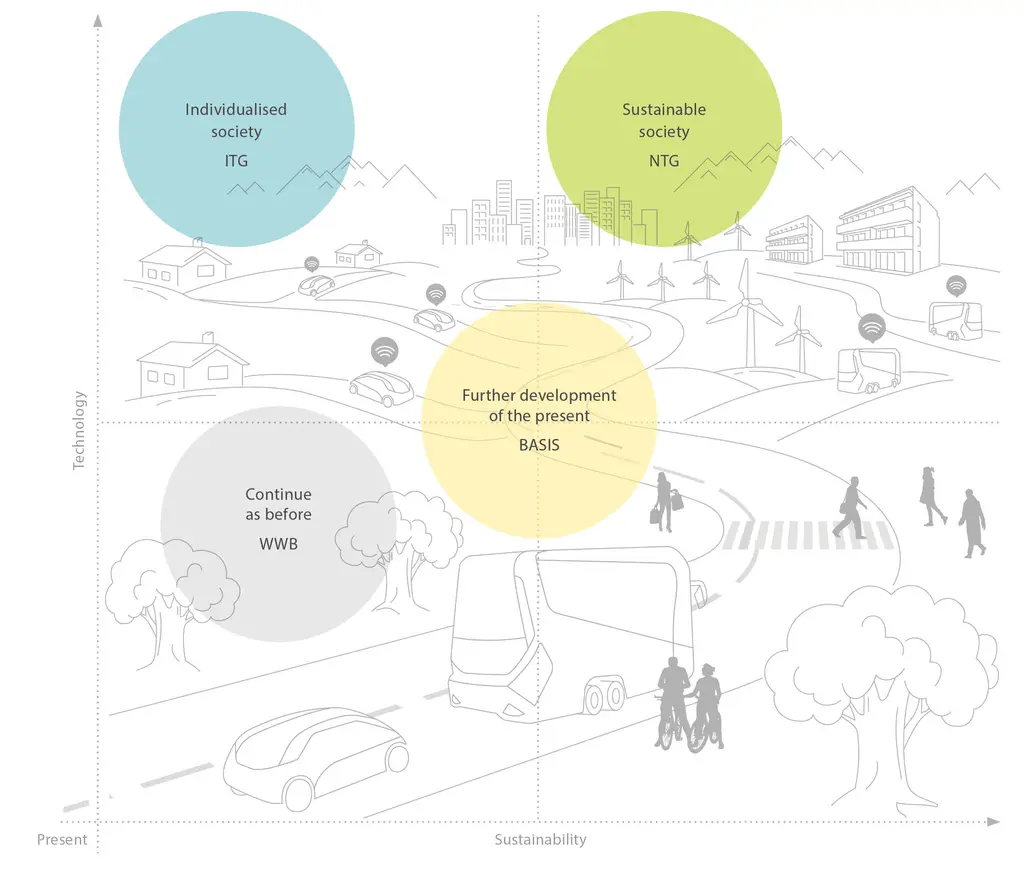
On the other hand, four scenarios are considered: Business as Usual (WWB), Basic (BASIS), Sustainable Society (NTG) and Individualised Society (ITG). The key points of these scenarios have been defined by the federal offices and represent different ‘what if’ worlds. WWB assumes a continuation of the current situation, while BASIS adopts the trends analysed in other federal studies and assumes the implementation of more far-reaching transport policy measures. Accordingly, BASIS also forms the core scenario of the transport perspectives. The effects of alternative development paths are analysed in two further scenarios: NTG assumes a future in which society consistently uses technological achievements in favour of greater sustainability, while in ITG society uses these achievements for increased individualisation.